What Are the Main Challenges Facing the Amazon Forest?
Deforested areas in the Amazon increased by 91% in May, according to data from the National Institute for Space Research (INPE) released on July 6. This marked the second-worst result in the historical series for that month, with 960 km² of forest cleared, compared to 502 km² in May 2024.
The link between deforestation and illegal wildfires is evident, as fire is often used as a tool for "clearing land." According to the Real-Time Deforestation Detection System (Deter), presented by the Ministry of the Environment and Climate Change (MMA), 51% of deforestation results from forest fires, 48% from clear-cutting, and 1% from mining.
Data released in April 2024 by the Amazon Institute of People and the Environment (Imazon) also show that 79% of recent deforestation occurred on private land (such as farms), with 16% in settlements, 5% in conservation units, and 1% in Indigenous territories.
What Causes Illegal Wildfires, and How Do They Occur?
As stated by Dr. Luciana Vanni Gatti, a researcher at INPE, “the surge of wildfires currently affecting Brazil is not a natural phenomenon.” Several industries in Brazil—agribusiness, livestock, mining, oil, and energy—profit from illegal deforestation. As explained by the president of IBAMA, Rodrigo Agostinho, in August 2024: “Cutting trees is expensive. Fire is much cheaper — you just buy gasoline and start spreading it.” This rationale helps to explain the intensity of the criminal fires, even amid a reported decrease in clear-cutting in the Amazon.
The loosening of environmental legislation further complicates monitoring and enforcement efforts. The so-called Deforestation Law Project (Bill 2159/2021) was approved by the Federal Senate on May 21 and by the Chamber of Deputies on July 17, 2025. Introduced by the agribusiness caucus, the bill weakens environmental licensing regulations and establishes a new legal framework to facilitate the regularization of development projects nationwide—a move that risks increasing both wildfire occurrences and deforestation rates.
What Vulnerabilities Do Local Communities Face?
Interference in the forest affects ecosystems that should be protected—such as Indigenous lands and extractivist reserves (traditional forest communities who harvest without deforestation) —directly impacting local communities and contributing to food insecurity.
In March 2024, Acre experienced severe flooding linked to climate change. Ninety-three Indigenous communities were affected, losing crops that would have sustained them for the entire year. According to the state government, marking the most severe environmental disaster in the state's history, displacing 10,700 people and affecting 86% of municipalities.
Currently, Acre is facing one of its most severe droughts in recent years. According to the National Water Agency (ANA), over 64% of the state’s territory was affected by drought in May, a 24% increase from the previous month.
Why is it Important to Protect Amazonian Sociobiodiversity?
At this critical moment—when climate change continues to break temperature records and the Earth edges closer to a point of no return—the Amazon Rainforest plays a vital role.
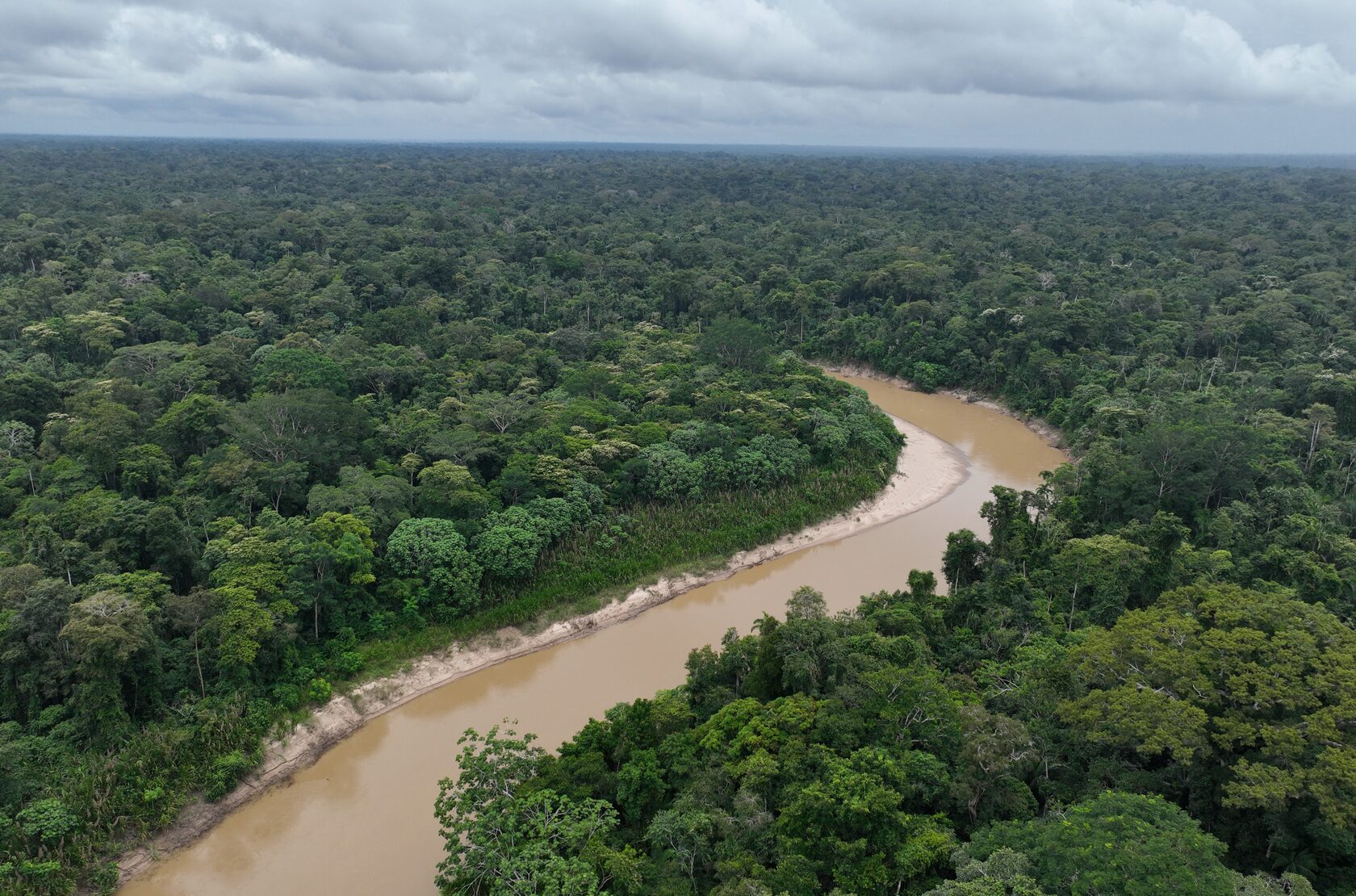
Spanning nine South American countries, the Amazon is one of the richest and most biodiverse ecosystems on the planet. As the world’s largest tropical forest, it is essential for sustaining life on Earth.
It functions as a carbon sink, absorbing CO₂ and helping combat the greenhouse effect. It shapes global weather patterns, prevents desertification, and is indispensable to climate stability.
Home to millions of species, the Amazon also provides valuable natural resources that support sustainable production chains, bioeconomic development, and above all, the food security of Indigenous and traditional communities.
What is SOS Amazônia?
In the 1980s, large areas of forest in the Amazon were converted into grazing land. At that time, the rubber tappers’ movement in the state of Acre came together to resist deforestation and secure land rights for their settlements.
Driven by the resistance of the forest guardians, on September 30, 1988, in Rio Branco (Acre), teachers, university students, and representatives of the social movement—including activist and rubber tapper Chico Mendes—founded the SOS Amazônia Association. Its primary goal was to protect the Amazon Rainforest by supporting traditional populations.
Historically, SOS Amazônia has played a key role in developing management plans for several Conservation Units, including the creation and oversight of the Serra do Divisor National Park in Acre. Overall, the NGO planted more than 2.1 million trees and directly supported 5,500 families.
It also strengthened cross-border cooperation between Acre (Brazil) and Ucayali (Peru), encouraging the exchange of practices for the sustainable use of forest resources and monitoring actions to protect biodiversity. Through its Amazon Firefighters project, the organization has facilitated community dialogues on reducing the use of fire in agriculture among rural and extractivist communities.
The organization was recognized as one of the 100 Best NGOs in Brazil, receiving the award in 2017, 2021 and 2022. Organized by Instituto Doar, this recognition honors excellence in nonprofit management and transparency while fostering a culture of philanthropy in Brazil.
In 2004, SOS Amazônia also received the Bem Eficiente Award for institutional management, granted by Kanitz & Associados to the 50 non-profit organizations in Brazil that most effectively and transparently manage their resources.
How Do SOS Amazônia’s Initiatives Address These Challenges?
The Protected Areas and Biodiversity Conservation engages in political action, contributes to deforestation monitoring, and works to protect endangered species through the Socioenvironmental Observatory of Acre.
In parallel, the Values of the Amazon program promotes the social empowerment of traditional populations and local socioeconomic development, generating income while preserving the standing forest through the Vegetable Oils Productive Chain, for example.
Additionally, the Forest Landscape Restoration program develops solutions, models, and practices for the restoration of degraded areas—aiming to preserve both ecosystem services and socioeconomic resilience through the Agroforestry Systems (SAFs).
How Do Agroforestry Systems Contribute to Local Food Security?
Agroforestry Systems (SAFs) are land-use practices that integrate agricultural crops, fruit and forest trees, and animals in a way that mimics natural forest ecosystems. Managed by extractivist families and cooperatives in Acre, SAFs help restore degraded areas while generating both food and income.
Initially, trees help improve soil quality, protect crops from pests, and provide shade for species that are not adapted to full sun. Over time, they begin to generate revenue through the collection of fruits, seeds, and firewood.
This process leads to the gradual development of a productive forest, with multiple crops grown simultaneously—boosting yields and eliminating the need to clear additional forest areas for cultivation.
How Can You Support Our Cause?
If you would like to learn more about our work and the Amazon forest communities, take a look on our website:
Text: Natália Juliano
Sources:
Instituto Nacional de Pesquisas Espaciais – INPE (2025, June 6). TerraBrasilis: Deforestation alerts – Amazon biome (aggregated data). https://terrabrasilis.dpi.inpe.br/app/dashboard/alerts/biomes/amazonia-nb/aggregated/
Greenpeace Brasil. (2025, June 6). Desmatamento. https://www.greenpeace.org/brasil/tag/desmatamento/
Imazon. (2025, April). Sistema de Alerta de Desmatamento (SAD) – Março de 2025. https://imazon.org.br/publicacoes/sistema-de-alerta-de-desmatamento-sad-marco-de-2025/
SOS Amazônia. (2019, September 21). Brazil in flames. https://sosamazonia.org.br/tpost/uh70n228l1-brazil-in-flames
Menezes, R. (2024, August 7). Desmatamento é caro, fogo é mais barato, explica presidente do Ibama sobre queimadas. Agência Pública. https://apublica.org/2024/08/desmatamento-e-caro-fogo-e-mais-barato-explica-presidente-do-ibama-sobre-queimadas/
g1 Acre. (2025, June 28). Com mais de 64% do território em situação de seca, autoridades do AC avaliam estratégia para amenizar prejuízos. https://g1.globo.com/ac/acre/noticia/2025/06/28/com-mais-de-64percent-do-territorio-em-situacao-de-seca-autoridades-do-ac-avaliam-estrategia-para-amenizar-prejuizos.ghtml
g1 Acre. (2024, March 2). Da seca extrema à cheia histórica: entenda os fatores climáticos que fazem o Acre viver nova emergência. https://g1.globo.com/ac/acre/noticia/2024/03/02/da-seca-extrema-a-cheia-historica-entenda-os-fatores-climaticos-que-fazem-o-acre-viver-nova-emergencia.ghtml
SOS Amazônia. (2024, April 22). Dia da Terra: A importância da Amazônia para o futuro do planeta. https://sosamazonia.org.br/tpost/mj7i8xb6k1-dia-da-terra-a-importncia-da-amaznia-par