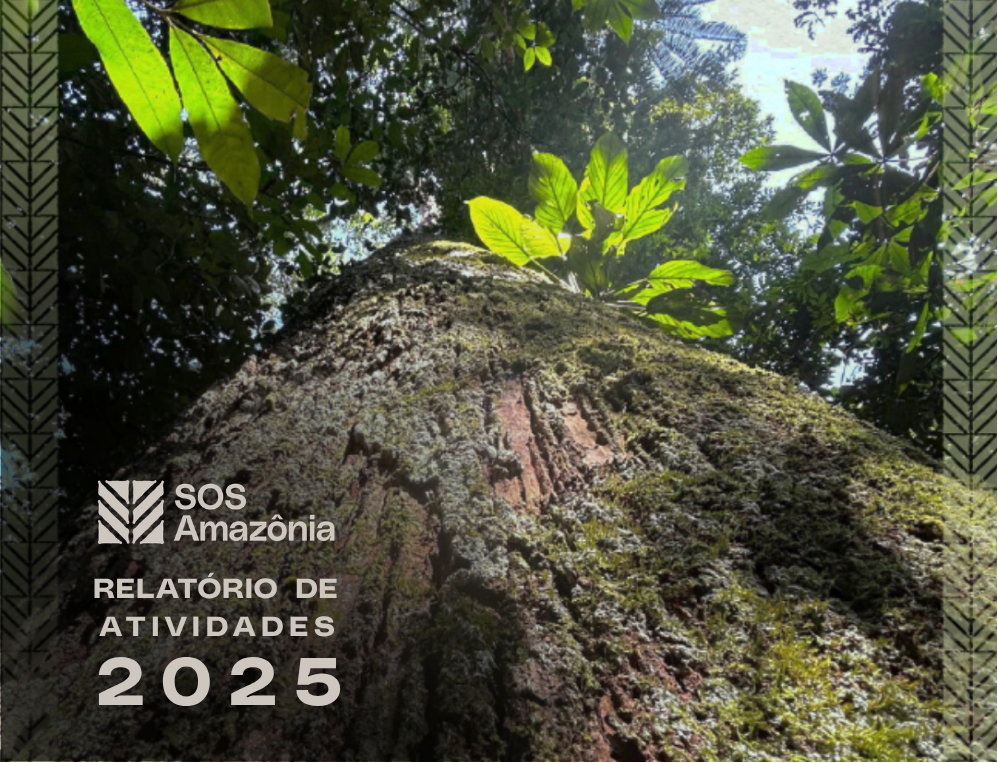
In a year marked by the challenges posed by the climate crisis and mounting pressure on Amazonian territories, SOS Amazônia consolidated an approach in 2025 that combines environmental conservation, ecosystem regeneration, income generation, and the strengthening of traditional communities. The organization’s Activity Report presents results demonstrating the impact of a strategy developed alongside Indigenous peoples, extractive communities, family farmers, community organizations, and national and international partners.
Over the course of the year, 638,599 seedlings were planted, contributing to the restoration of 566 hectares of degraded land and the recovery of 67 headsprings, thereby strengthening water security and territorial resilience in the face of climate change. These efforts directly involved more than 5,000 people—including women, youth, and Indigenous peoples—in initiatives that combine ecological restoration with sustainable development.
Over the course of the year, 638,599 seedlings were planted, contributing to the restoration of 566 hectares of degraded land and the recovery of 67 headsprings, thereby strengthening water security and territorial resilience in the face of climate change. These efforts directly involved more than 5,000 people—including women, youth, and Indigenous peoples—in initiatives that combine ecological restoration with sustainable development.
Check out the complete SOS Amazônia 2025 Activity Report.
Another highlight was the strengthening of socio-biodiversity value chains. Work with women seed collectors resulted in the sale of 5,311 kg of forest seeds, generating over R$82,000 in income for women's community groups. At the same time, organizations supported by SOS Amazônia generated approximately R$1 million through the production of herbal medicines and forest products, demonstrating that keeping the forest standing also creates sustainable economic opportunities.
Another highlight was the strengthening of socio-biodiversity value chains. Work with women seed collectors resulted in the sale of 5,311 kg of forest seeds, generating over R$82,000 in income for women's community groups. At the same time, organizations supported by SOS Amazônia generated approximately R$1 million through the production of herbal medicines and forest products, demonstrating that keeping the forest standing also creates sustainable economic opportunities.
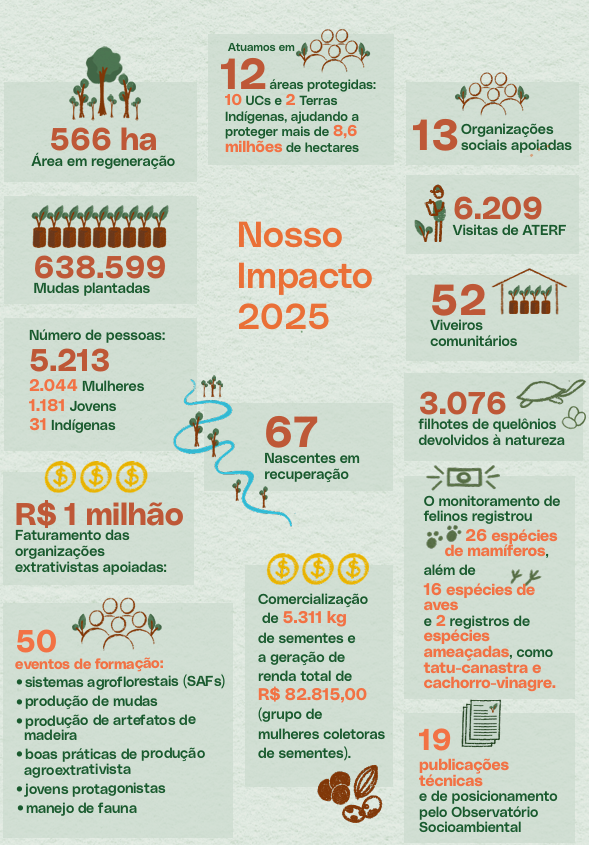
On the biodiversity conservation front, the Quelônios do Juruá Project released 3,076 turtle hatchlings into the wild, thanks to the collaborative efforts of the technical team and volunteer conservation agents. Wildlife monitoring recorded 26 mammal species and 16 bird species—including threatened ones such as the giant armadillo and the bush dog—underscoring the importance of protecting Amazonian territories.
The organization also expanded its work in advocating for public policies and driving socio-environmental impact. In total, SOS Amazônia operated in 12 protected areas—comprising both Conservation Units and Indigenous Territories—contributing to the protection of over 8.6 million hectares of forest and supporting 13 social organizations working directly on conservation and sustainable development in the region.
The organization also expanded its work in advocating for public policies and driving socio-environmental impact. In total, SOS Amazônia operated in 12 protected areas—comprising both Conservation Units and Indigenous Territories—contributing to the protection of over 8.6 million hectares of forest and supporting 13 social organizations working directly on conservation and sustainable development in the region.
SOS Amazônia also worked to expand and strengthen environmental awareness through communication, including mobilizing opposition to the "Devastation Bill," with the collaboration of activists and local figures such as Raimundão, Camila Cabeça, Mapu Huni Kuin, Victor Onofre, and Kellen Mendes.
For Álisson Maranho, technical secretary at SOS Amazônia, the results represent more than just metrics. "Each restored area, each recovered spring, each strengthened community, and each young person involved demonstrates that protecting the Amazon also means investing in the people who live there. The report reflects this collective effort and reaffirms that a standing forest remains the best response to the climate crisis."
For Álisson Maranho, technical secretary at SOS Amazônia, the results represent more than just metrics. "Each restored area, each recovered spring, each strengthened community, and each young person involved demonstrates that protecting the Amazon also means investing in the people who live there. The report reflects this collective effort and reaffirms that a standing forest remains the best response to the climate crisis."
The 2025 Activity Report highlights that conserving the Amazon requires integrated solutions. By linking forest restoration, support for forest communities, the strengthening of socio-biodiversity, and policy advocacy, SOS Amazônia continues to pave the way for the forest to remain alive, productive, and protected for future generations.
Join the movement to protect and conserve the standing forest and its biodiversity! Support us and donate now.
Join the movement to protect and conserve the standing forest and its biodiversity! Support us and donate now.