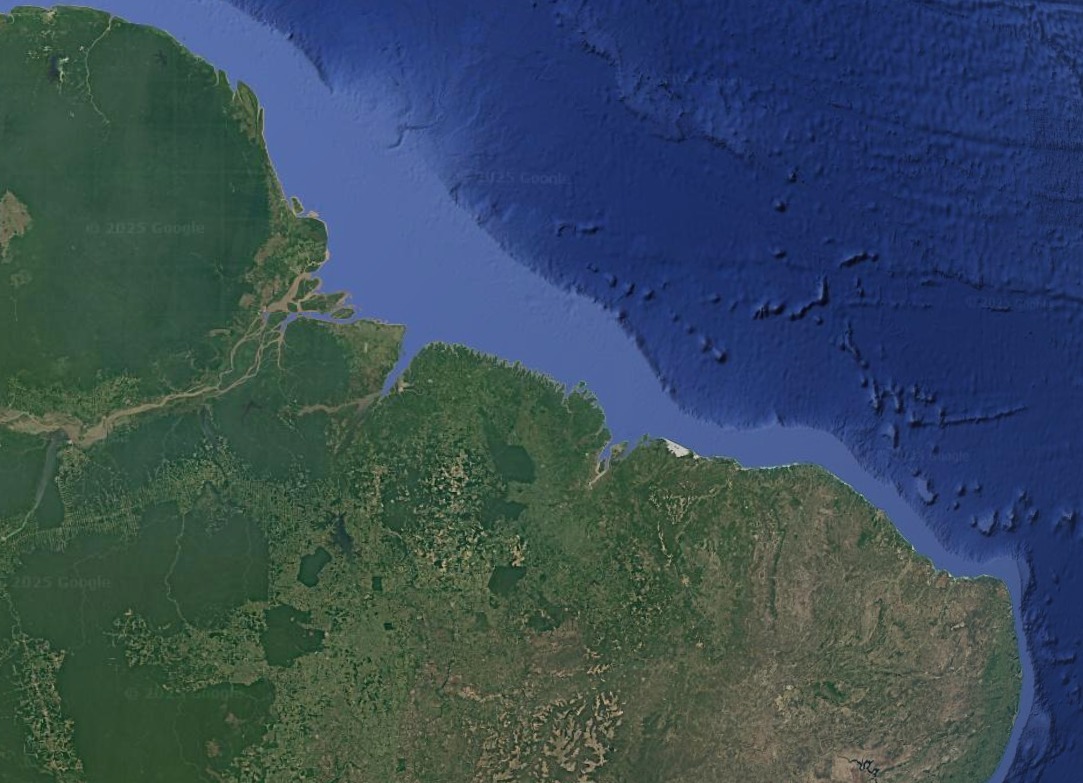
The Amazon River Mouth Basil’s oil exploitation has returned to the centre of debate after Ibama (Brazilian Institute of Environment and Renewable Natural Resources) granted authorization to Petrobras to conduct exploratory research in the region. The decision was made in October 2025, a few days before the start of COP30, held in Belém, which intensified criticism to the federal government.
The licensing process had been underway at Ibama since 2013. In 2025, it received authorization for exploratory drilling in block FZA-M-059, located approximately 175 km off the coast of Amapá, in an open sea and deep water area. This permit represents another step towards the possible definitive approval of exploration in the Amazon River Mouth Basin, which, according to experts, could compromise environmental integrity and local biodiversity.
The area is considered environmentally sensitive and rich in biodiversity. It is home to the Great Amazon Reef System, recently discovered and still under study by scientists. The region also harbors the largest continuous mangrove corridor on the planet, fundamental for the maintenance of fauna and flora and for the subsistence of coastal populations that depend directly on these ecosystems.
Geographer and master's degree holder in Territorial Development of Latin America and the Caribbean, Daniela Dias, highlights the socio-environmental impacts of the activity. According to her, the basin is still poorly studied from an ecological point of view and presents characteristics that increase the risks: “It is a region with a very rich reef system and strong ocean currents. In case of an accident during drilling, we would be talking about a possible oil spill in an area with extremely diverse fauna and flora,” she explains.
In the social context, Dias adds that the region is mostly made up of traditional populations. For her, a potential accident could generate a devastating chain reaction: "We are talking about people who could lose their main source of food and maintenance."
Another point raised is the contradiction between the expansion of oil exploration and the climate commitments made by Brazil under the Paris Agreement, which foresees efforts to reduce greenhouse gas emissions and, consequently, dependence on fossil fuels. According to Daniela Dias, this is an incoherent discourse: "It is necessary to define priorities, especially when we talk about biodiversity conservation," she states.
The promise of economic and social development is also questioned. The "Until the Last Drop" project, by InfoAmazonia, points out that other Amazonian regions—including in neighboring countries where the biome extends—have not experienced the promised benefits after decades of oil exploration. According to research, more than 50 years of activity have resulted mainly in increased social inequalities and environmental degradation.
Concerns about potential leaks gained momentum in early January 2026, when Petrobras confirmed a leak of drilling fluid. Although the company stated that the material is biodegradable and does not cause significant environmental impacts, the incident reinforced warnings about the region's vulnerability to oil activity.
In a statement, the Articulation of Indigenous Peoples and Organizations of Amapá and Northern Pará (Apoianp) and the Council of Chiefs of the Indigenous Peoples of Oiapoque (CCPIO) stated that the incident highlights the risks of oil exploration. "Oil activity in our coast is a threat to the marine and coastal ecosystems on which our peoples, especially those of Oiapoque, depend for their physical and cultural subsistence," the organizations emphasized.
The licensing process had been underway at Ibama since 2013. In 2025, it received authorization for exploratory drilling in block FZA-M-059, located approximately 175 km off the coast of Amapá, in an open sea and deep water area. This permit represents another step towards the possible definitive approval of exploration in the Amazon River Mouth Basin, which, according to experts, could compromise environmental integrity and local biodiversity.
The area is considered environmentally sensitive and rich in biodiversity. It is home to the Great Amazon Reef System, recently discovered and still under study by scientists. The region also harbors the largest continuous mangrove corridor on the planet, fundamental for the maintenance of fauna and flora and for the subsistence of coastal populations that depend directly on these ecosystems.
Geographer and master's degree holder in Territorial Development of Latin America and the Caribbean, Daniela Dias, highlights the socio-environmental impacts of the activity. According to her, the basin is still poorly studied from an ecological point of view and presents characteristics that increase the risks: “It is a region with a very rich reef system and strong ocean currents. In case of an accident during drilling, we would be talking about a possible oil spill in an area with extremely diverse fauna and flora,” she explains.
In the social context, Dias adds that the region is mostly made up of traditional populations. For her, a potential accident could generate a devastating chain reaction: "We are talking about people who could lose their main source of food and maintenance."
Another point raised is the contradiction between the expansion of oil exploration and the climate commitments made by Brazil under the Paris Agreement, which foresees efforts to reduce greenhouse gas emissions and, consequently, dependence on fossil fuels. According to Daniela Dias, this is an incoherent discourse: "It is necessary to define priorities, especially when we talk about biodiversity conservation," she states.
The promise of economic and social development is also questioned. The "Until the Last Drop" project, by InfoAmazonia, points out that other Amazonian regions—including in neighboring countries where the biome extends—have not experienced the promised benefits after decades of oil exploration. According to research, more than 50 years of activity have resulted mainly in increased social inequalities and environmental degradation.
Concerns about potential leaks gained momentum in early January 2026, when Petrobras confirmed a leak of drilling fluid. Although the company stated that the material is biodegradable and does not cause significant environmental impacts, the incident reinforced warnings about the region's vulnerability to oil activity.
In a statement, the Articulation of Indigenous Peoples and Organizations of Amapá and Northern Pará (Apoianp) and the Council of Chiefs of the Indigenous Peoples of Oiapoque (CCPIO) stated that the incident highlights the risks of oil exploration. "Oil activity in our coast is a threat to the marine and coastal ecosystems on which our peoples, especially those of Oiapoque, depend for their physical and cultural subsistence," the organizations emphasized.